














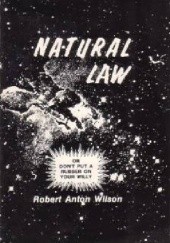
cytaty z książki "Natural Law or Don't Put a Rubber on Your Willy"
katalog cytatów
I am agnostic about that god, as about all gods, but I am not smart enough to be an atheist.
 acwo
acwo

The function of Theological and Ideological hypnosis is to forget the common sense and follow the robot-program that evades the responsibility of thinking and feeling anew in each unique situation.
acwo
Ideology should more properly be called idiocy: we harbour the suspicion that the “deep beliefs” and “moral passions” associated with Ideologies tend to make people behave like lunatics (or like badly-wired robots) and that strong doses of skepticism and down-to-earth pragmatism appear to be the only factors that have ever produced any relative sanity or relative peace anywhere. We agree that passionate ideology and “deep” belief (i.e. deliberate blindness) indeed makes for political success and has created history as we know it, but that is precisely why we find politics and history so terrible to contemplate.
acwo
The search for certitude — like the pretence or moral righteousness — appears to me as a medieval habit that should have vanished long ago. None of us knows enough to be certain about anything, usually, and none of us are nearly as “moral” as we feel obliged to pretend we are in order to be acceptable in “Decent” Society.
acwo
The Cosmic Schmuck Principle holds that if you don’t wake up, once a month at least, and realize that you have recently been acting like a Cosmic Schmuck again then you will probably go on acting like a Cosmic Schmuck forever; but if you do, occasionally, recognize your Cosmic Schmuckiness, you might begin to become a little less Schmucky that the general human average at this primitive stage of terrestrial evolution.
acwo
The only way to learn anything, for a person of limited intelligence, is to listen to as many diverse views as possible.
acwo
The case for individualism rests entirely on the fact that, each individual being neurologically-experimentally unique, each individual, however “queer” or “perverse” or “alien” they may seem to local prejudice, probably knows something that no other individual has ever noticed. We all have something to learn from one another, if we stop trying to ram our dogmas down everybody else’s throat and listen to one another occasionally.
acwo
Natural Law appears to be a map that does not correspond to any real territory,
but like other Idols it becomes almost “real” when the worshipper stares at it long enough with passionate adoration.
acwo
Aristotle originated and Thomas Aquinas developed the idea of the world made up of “entities” each possessing and indwelling “nature,” which can be known by abstract reasoning from abstract definitions.
This survives in the Cartesian philosophy of “the ghost in the machine,” because Descartes assumed block-like mechanisms, instead of block-like entities. but left them still haunted by spiritual essences. We shall return to this point in detail, but for now it is enough to mention that science has not employed this Aristotelian-Thomist-Cartesian model for over 300 years. Science does not assume “natures”
spookily indwelling “within” things, at all, at all. Science posits functional relations between “things” or events. These functional relations can also be called patterned coherencies or, in Bucky
Fuller’s terminology, “knots” — energy patterns and interferences between energies. All scientific models describe such energy “knots” between “things” and not spookily indwelling “within” “things.”
Science also increasingly doubts the existence of “things” in the Thomist sense and speaks more of relations between space-time events. I am not asserting that science has “refuted” the Aristotelian-Thomist model, but just that science has found that model useless in discussing the sensory-sensual world of space-time. In other words, even if the Aristotelian-Thomist model refers to something, it does not refer usefully to our existential experience and experiments in space-time. The Aristotelian-Thomist model, as we shall see, refers to some ghostly realm “above” or outside of space-time.
acwo
Blake said, “One Law for the Lion and Ox is tyranny.” But even more, one “truth” for the Lion and Ox is impossible. There will always be different lanes for different brains, different scenes for different genes, different strokes for different folks.
acwo
Propositions of theology are not considered scientifically “meaningful” because they are so defined as to negate the possibility of refutation — to evade experimental testing entirely.
acwo
A scientifically meaningful generalization deals with events that can be observed by humans, even if it requires special instruments to observe them. Things that can never be observationally detected even in principle, do not have any scientific meaning.
acwo